Review: And Then You Die by James H Longmore

I can’t describe what sort of taste was left in my mouth after reading James H Longmore’s …and Then You Die, a novel that marks my entry into the genre of bizarro, where absurdism and satire meet the weird and grotesque. If you find the concept of bizarro off-putting, then …and Then You Die  is not a book for you! But you’d be missing out on an extraordinarily visceral cultural experience.

“Following a drunken, hedonistic night out on the town in New Orleans, successful businesswoman and sexual deviant Claire Jepson accidentally soils herself in her expensive car. The resulting excrement comes to life as a terrifying, sardonic fecal spirit and not only dishes out a particularly gruesome death to Claire’s unfaithful, gold digging fiancé, but also thwarts a kidnap/murder plot by her employees and introduces Claire to a world of depraved pleasures beyond even her depraved imagination.

A year later, the errant spirit has spiraled wildly out of control with its insatiable appetite for perverted sex and human flesh and has destroyed both Claire’s business and life.

To her horror, Claire then discovers that the fecal spirit plans to consume her unborn child in order to attain immortality and she must return to the seedy underbelly of the Big Easy where her nightmare began in a heart-pounding race against time to confront the spirit’s creator; a high priest of a most ancient and deadly order, who is the only one who can put a stop to the spirit’s murderous intentions.

A wicked, fast-paced story laced with tongue-in-cheek, dark humor and which is at the same time incredibly erotic and stomach churning; definitely not one to be read whilst eating!”

Take heed of that last comment!

I consumed, no I devoured …and Then You Die, an off-the-wall tale laced with hilarity and an astonishing wit. Longmore does not mince his words, confronting the reader at every turn with the utterly detestable, lifting up the toilet lid on the excrement most prefer to flush away, and  bringing it to life in quasi-human form.

…and Then You Die is a sexy, earthy romp of the most deviant order. In protagonist Claire Jepson, a dot com businesswoman, Longmore makes a not so subtle comment on the debauched perversions of the moneyed classes. Through the protagonist’s initial accidental soiling, Longmore brings to life the shit pile. In an extraordinarily detailed expose, …and Then You Die goes on to explore in depth and in breadth every aspect of living shit.

Longmore’s pacing is excellent, the action never wanes, plot twists driving the tale into greater depths of degradation arriving on cue. The narrative contains a solid, four to the floor rhythm, a forward driving pulse that makes …and Then You Die a delight to read.  The author’s wit shines from every page, right down to his shit-in-the-bag entity that morphs into an antagonist with a voice like Russell Brand. Ever since Franz Kafka’s Metamorphosis, in which the main character wakes up to find he is a giant bug, authors have played with the grotesque in the paranormal. Longmore has penned a work of excellence, both in the quality of writing and in his ability to sustain a work that pivots on a single metaphor: shit.

…and Then You Die will appeal to lovers of dark comedy. Be warned! This is not a story for those with refined sensibilities easily offended by in-your-face revulsion. Think kinky and twisted Iain Banks.


Review: On the Job by Sandi Wallace

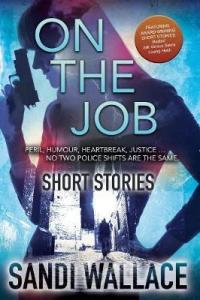
I’m delighted to present my review of On The Job by Australian crime author, Sandi Wallace.


“The highs and lows of cops on the job. The cases that make them, break them, bring them laughs, maybe even love. Police on the beat, working one-officer shops and seasoned detectives pursue a cunning home intruder, a full-moon prankster, false friends, vengeful partners. Adrenaline-charged car chases, unsanctioned surveillance, intense interrogation. The impact of a child’s tragic death. The import of unearthing what happened to an infant and her mother. Lives saved and crooks captured. This gripping collection of Sandi Wallace’s award-winning short fiction–“Busted,” “Silk Versus Sierra” and “Losing Heidi”–along with new and never-before released verse and stories, includes “Impact,” a finalist in the international Cutthroat Rick DeMarinis Short Story Contest. ”

As ever with Sandi Wallace, each story in On The Job has the reader settling into a relationship of trust from the first paragraph, confident that the journey will satisfy. Wallace is a courageous writer, tackling the confronting and hard-hitting with sensitivity and depth of understanding. Her protagonists, the cops ‘on the job’, are sharply crafted and authentic. Wallace’s storytelling draws the reader up close, experiencing the reactions of investigating officers as they solve crimes and bang to rights the perpetrators.

Little wonder the stories here have won awards. Wallace charms her readers with tales that not only grip, they present socially realistic worlds, especially of rural Australia. There can be no doubt the author has done her research. These are stories that linger, long after they are read, and after experiencing the works of Sandi Wallace I, for one, will never imagine rural Australia in quite the same way again. This collection does not disappoint.


Shopping List 2 – an outstanding horror collection


“HellBound Books Publishing brings you an outstanding collection of horror, dark, slippery things, and supernatural terror – all from the very best up and coming minds in the genre. We have given each and every one of our authors the opportunity to have their shopping lists read by you, the most wonderful reading public, and have the darkest corners of their creative psyche laid bare for all to see…

In all, 21 stories to chill the soul, tingle the spine and keep you awake in the cold, murky hours of the night…”

Mine is called ‘Ignominy’

About a year ago I signed up for a free online creative writing course as research for running my own. In those ten weeks participants were invited to write the bones of a short story. I came up with plain Jane on a train. Yeah, I guess I was feeling a bit cynical and detached as I was really just being a spy, but I jumped through the hoops and engaged anyway.


Then I tinkered with this Jane and her train journey, and the more I did, the darker the story became. The result is ‘Ignominy’, a dark tale about a train journey, describing where Jane has been, who she meets, and what happens as a result.

I ended up loving Jane so much I employed the same style in a novel-length work, which I am hoping will be published next year.

You can order a copy of this anthology, available in all formats, and enjoy all the other dark tales it contains here.

Enjoy!!!

The Tides Between by Elizabeth Jane Corbett

I am delighted to share my review of Elizabeth Jane Corbett’s debut novel, The Tides Between.

“In 1841, on the eve of her departure from London, Bride’s mother demands she forget her dead father and prepare for a sensible, adult life in Port Phillip. Desperate to save her childhood, fifteen-year-old Bridie is determined to smuggle a notebook filled with her father’s fairy tales to the far side of the world.

When Rhys Bevan, a soft-voiced young storyteller and fellow traveller realises Bridie is hiding something, a magical friendship is born. But Rhys has his own secrets and the words written in Bridie’s notebook carry a dark double meaning.

As they inch towards their destination, Rhys’s past returns to haunt him. Bridie grapples with the implications of her dad’s final message. The pair take refuge in fairy tales, little expecting the trouble it will cause.”

My Review

Told from three viewpoints, Elizabeth Jane Corbett’s debut novel is a fearless yet endearing exploration of the day-to-day existence of a small cast of characters, each with their troubles, who are incarcerated along with numerous families in the steerage deck of a ship bound for Australia. The Tides Between is an ironic tale in some ways, for the duration of a voyage that spans half the globe, the epic journey that unfolds is one situated at the hearth of human existence.

Corbett writes with a deft pen. The author is unafraid to expose the reality of life for working class migrants making the treacherous voyage to Australia. In true literary fashion, the narrative presses forward through the unfolding realisations of its characters, the backstory interwoven in fragments.

The Tides Between opens with fifteen-year old Bridie clutching a notebook of fairy stories she was forbidden to keep as she boards a ship bound for Port Phillip. What unfolds is in part a coming of age story, as Bridie learns to handle the grief she feels at the loss of her father, and accept the benevolent affections of her stepfather, Alf. Yet The Tides Between is less a story of one girl’s entry into adulthood and more a meditation on trauma and its consequences, and on identity and the power of myth.

These themes are strikingly played out through Rhys, a young Welshman and miner’s son crippled by claustrophobia.  His wife, Sian, is pregnant, as is Bridie’s mother. Will either woman manage to safely birth her child before the ship pulls in at its destination? Will Rhys transcend his anguish? Will Bridie shake off her adolescent ill humour? Can Alf, a man strangled by his sense of duty and obedience, find the courage to confront the ship’s surgeon?

Corbett carries her plot forward with intricate attention to emotional detail. The heaving waters of the various oceans traversed a powerful metaphor for those heaving in the hearts of protagonists Bridie, Rhys and Alf.

Corbett’s writing is visual, metaphoric and intelligent.

“The night air fell like a chill shawl on her shoulders. Turning back towards the hatchway, she heard an eerie drawn out sound from beyond the deckhouse. She halted, nerves feathering her spine.”

It is in this fashion that dramatic tension is maintained, the reader treated page after page to Corbett’s elegant prose.

The theme of fairy tales is prominent, but these are not the stories of children’s books. They are powerful myths rich with significance. Bridie strives to make sense of the world and relationships through the lens of fairy tales, questioning, comparing, speculating. Corbett juxtaposes Bridie’s musings with the reality of her situation, conveyed through the harsh, albeit sensible worlds of her mother.    Meanwhile, Rhys grapples with his own demons. The only time he can cope with being in steerage is when he is on stage, telling Welsh fairy tales to a captive audience. Through the friendship that grows between Bridie and Rhys, Corbett explores the healing power of fairy tales, a release as much for the teller as the listener.

In one respect, The Tides Between is a vivid portrayal of life in steerage. The reader is there with the stench and the lice and the privy buckets. Just as she is unflinching when it comes to portraying the physical hardships onboard, Corbett casts a microscopic eye over the complexities of grief and shame, taboos and social rejection.

Despite its heartrending moments, The Tides Between is ultimately a story of redemption, transformation and hope.

“She had begun to treasure their moments together, like bright beads, slipping through her fingers and puddling at the bottom of memory’s purse.”

The Tides Between pulls the reader in two directions, the desire to continue turning the pages at odds with an equally a strong wish to pause and reflect on its various intricacies, its depth. The only difficulty faced in reviewing a book of this quality is putting it down long enough to scribe reflections. A work I would describe as literary historical fiction, The Tides Between, is a captivating and immersive read.


Artefacts and other stories by Rebecca Burns

I’m delighted to share my review of Artefacts and other stories by Rebecca Burns


That dandelion. A flash of stubborn yellow in a dark box of space. It had promised sunshine but had tasted sour. Artefacts. A dandelion. A mayfly. A family, bereft. Items and mementos of a life, lived hard and with love, or long, empty, bitter. In these sharply drawn and unflinching short stories, Rebecca Burns unpicks the connection between the lives we live and what we leave behind.

My Review

The short story form is hard to master. There are many strictures and the word length alone demands taut and pointed prose. Few can manage the heights of Alice Munro. The reader waits for that release of breath as the author provides an astute observation or an elegant and original turn of phrase. Which is why, when I read this latest offering from Rebecca Burns, my mind was switched to critical.

Yet from the first, Burns satisfies the aspirations of the short-story reader, with sublime writing and masterful control, finely balanced with moments of apt poetry.

“She soothed his craggy face into easy, jelly smiles.”

And

“A quick tongue ready to cut through the fudge of clerical life.”

Alice Munro writes of everyday life in Canada. In a similar fashion, Burns turns her attention to the everyday lives of her characters, many set in the period of the world wars, others in the collieries of central England. All her stories are told with sensitivity and compassion. If there was one word to sum up this beautiful collection, it is depth, for Burns has plumbed to the nadir of her own self in the writing, at once never failing to miss a moment of irony. Highly recommended.

Dead Again by Sandi Wallace

The second in Wallace’s rural crime series, Dead Again is a fast-paced thriller set in the fictitious town of Bullock in the Yarra ranges east of Melbourne, and in the historic spa town, Daylesford.

“It is almost two years since wildfires ravaged the tiny town of Bullock, and Melbourne journalist, Georgie Harvey, is on assignment in the recovering town to write a feature story on the anniversary of the tragedy.

In nearby Daylesford, police officer, John Franklin, is investigating a spree of vandalism and burglaries, while champing to trade his uniform for the plain clothes of a detective.

When Georgie’s story and Franklin’s cases collide, she not only finds herself back in conflict with the man she’s been trying to forget since their first encounter, but she uncovers the truth about how the fires started – a truth no-one is wanting to believe.”

My Review (first appeared on the website of Sisters in Crime)

Dead Again opens with a perpetrator consumed by guilt for a crime he doesn’t reveal. From the first, the reader knows a little more than city journalist Georgie Harvey and Daylesford cop John Franklin. What unfolds is a flawlessly plotted unravelling of a heinous truth. The plot, jump cutting between the two protagonists, never stumbles. The story architecture that leads to a dramatic conclusion is convincing and plausible. Sub plots provide pleasing texture, driving the story forward, affording the necessary complications and frustrations. The result is a rich and satisfying tale.

Catch up on the novel’s predecessor is deftly handled. Georgie and Franklin have history, one that is unresolved. Franklin is consumed by an unwavering passion. Georgie is conflicted, her relationship with hot shot lawyer AJ, on the rocks. Wallace develops her characters with considerable finesse. It isn’t easy creating emotional character arcs in a novel heavy with plot. It appears Wallace has a hunger for Wallander in rural Victoria. Both Georgie and Franklin are introspective, troubled, frustrated and hurt. They are mirrors of each other, yet distinct. Wallace applies the same character-developing care in her antagonist. The reader will be forgiven for feeling some initial sympathy for a figure who has plainly committed some terrible act.

Dead Again is a brave book. The theme, termed Red Victoria in the narrative, concerns the Black Saturday bush fires of 2009. The horrors of that day cannot be erased from collective memory. The trauma lives on. Stepping into this terrain is dangerous, the author will inevitably be accused by some as cannibalising the tragedy of others for personal gain, a vulture, picking over trauma as though it were carrion. Worse, misconstruing or trivialising real events. These are unfair accusations. Authors travel where their muse takes them. Besides, Wallace is well aware of the dangers. The author treads lightly, defensively, tentatively, as does her protagonist, Georgie, the city-dwelling outsider on an assignment to write a magazine feature.

“’It’s impossible to describe. It’s a unique sound. Terrifying. And I hear the death screams of humans and animals.’ Gravelly, she added, ‘Ever heard that?’

Not trusting her voice, Georgie shook her head.

‘I feel the ghosts of my friends. This is stuff that I wouldn’t believe if it hadn’t happened to me. It keeps me awake at night.’ She rolled her eyes. ‘Hour upon hour, every single night. And the smells…’ Kelly shuddered.

It felt cruel to want more, but Georgie hung on each word.”

In this fashion, the wildfire theme is handled with respect and consideration, like an artefact held in the hand and turned over, sensitively scrutinised.

All the incidentals in the story are carefully researched, adding to the social realism that the author strives for. With wit and a sharp eye for the essentials, Wallace has built a story world that feels real. A page turner with much to savour, Dead Again is a moving and highly engaging read.

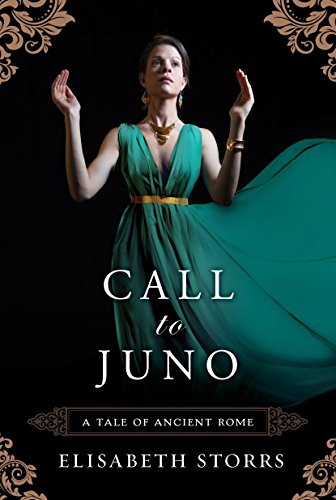
Call to Juno (A Tale of Ancient Rome Book 3) by Elisabeth Storrs

I am delighted to share my review of Elisabeth Storr’s Call to Juno, the third book in the Tales of Ancient Rome saga, which includes The Wedding Shroud and The Golden Dice. I haven’t read the first two in this series.

“Four unforgettable characters are tested during a war between Rome and Etruscan Veii.

Caecilia has long been torn between her birthplace of Rome and her adopted city of Veii. Yet faced with mounting danger to her husband, children, and Etruscan freedoms, will her call to destroy Rome succeed?

Pinna has clawed her way from prostitute to the concubine of the Roman general Camillus. Deeply in love, can she exert her own power to survive the threat of exposure by those who know her sordid past?

Semni, a servant, seeks forgiveness for a past betrayal. Will she redeem herself so she can marry the man she loves?

Marcus, a Roman tribune, is tormented by unrequited love for another soldier. Can he find strength to choose between his cousin Caecilia and his fidelity to Rome?

Who will overcome the treachery of mortals and gods?”

My Review

Call to Juno opens on a simple domestic scene, a mother watching over her squabbling children. A scene universal and timeless, yet one that is situated firmly in an Etruscan court. All the indicators are present, in the richly described and meticulously accurate details of the setting, the reader left in no doubt that she has been transported back to ancient Roman times. In this fashion the third in Storr’s series is staged, as Caecilia, a Roman treaty bride, helps her husband Vel Mastarna prepare for an important ceremony.

The reader is led through the details of the previous titles in the series with finesse. If at first the various characters are confusing, the story soon settles in and the drama plays out. The battle scenes are depicted in fine detail, themes of love, betrayal, fate and destiny deftly handled, and the characters carefully crafted and believable.

It is refreshing to read of Roman times from a distinctly feminine perspective, one that captures the intimacy of motherhood and domesticity as much as it does the political horrors of war.  Storrs maintains narrative control throughout, displaying that necessary skill of the historical fiction author, a deep empathy with the times she has chosen to set her work.

This is a story for those who enjoy their historical fiction rich with fine and accurate detail. Call to Juno is intensely visual, bringing ancient Rome to life, composed by an author who clearly knows her subject.

Charles La Trobe and my visit to the State Library of Victoria

It’s funny, the places a writing project will take you, especially when the project is historical fiction. Last week I visited the State Library of Victoria. I wanted to view the building, explore the library and talk with librarians. I didn’t allow sufficient time. I needed a whole day.

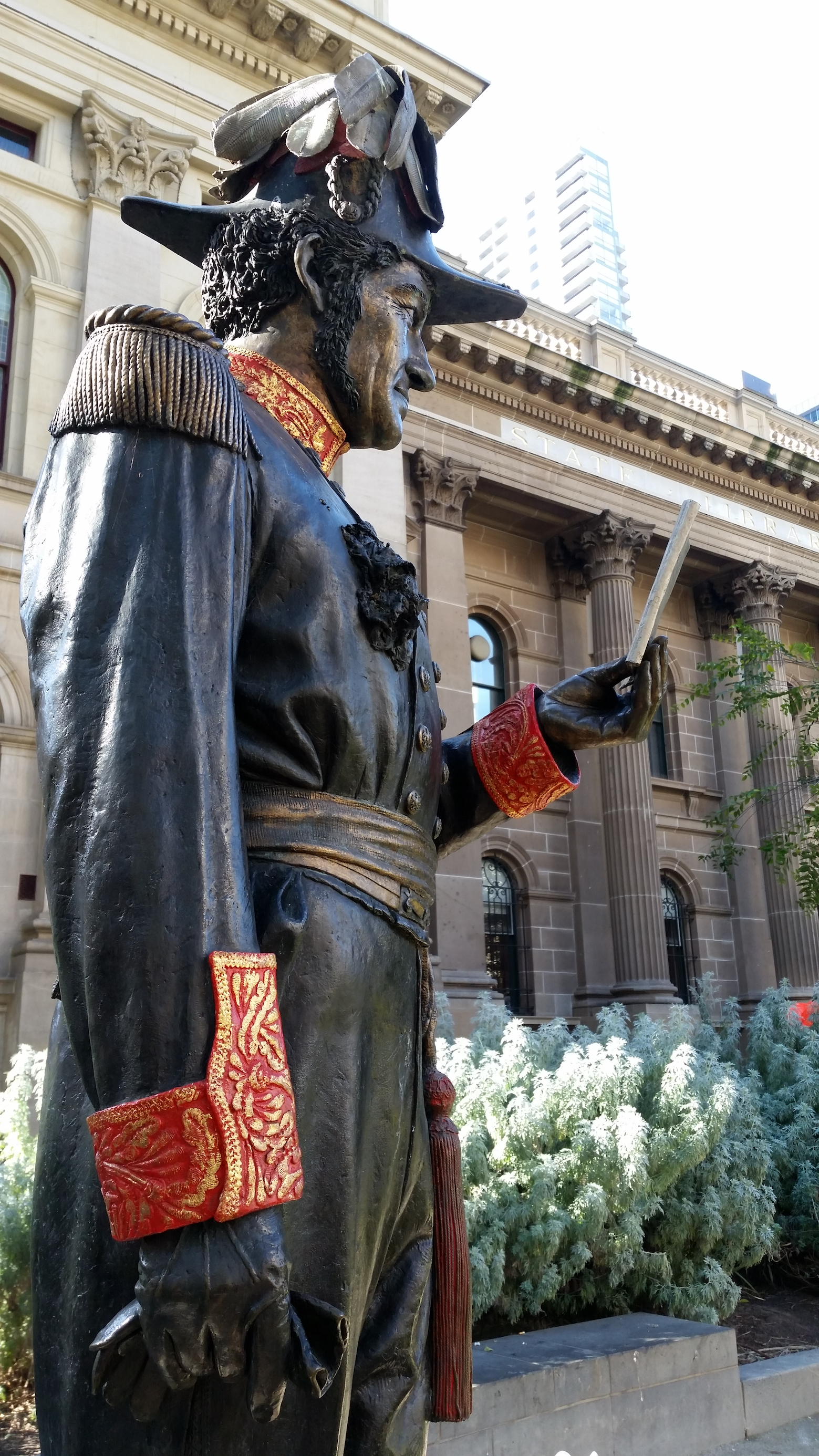
To start my little tour, I went to stand by the statue of Victoria’s first governor. Charles La Trobe is a member of the aristocratic La Trobe-Bateman family. He and his cousin, book illuminator and garden designer Edward La Trobe, both came to Australia in the 1800s, while the rest of the family remained in Britain. It was Charles La Trobe’s idea to have a public library built in Victoria. His statue depicts him in glorious fashion, the sculptor obviously wanting to appeal to the governor’s vanity. Other artists have been less kind, as can be seen on the front cover of his newly published biography, LaTrobe:traveller, writer, governor,  composed by John Barnes, Professor of English at La Trobe University.


From my vantage beside the statue I took in the library in all its grandeur. It’s impossible not to be impressed with the building, designed by Joseph Reed in Roman Revival style. It was officially opened in 1856, although not in its current form. The building is constructed from Tasmanian freestone, replete with rounded arched windows, and Ionic fluted columns on the portico. I admired the checkerboard tiled floor, which seemed to mirror the chess games being played, large scale, out on the grounds.

Redmond Barry Reading Room

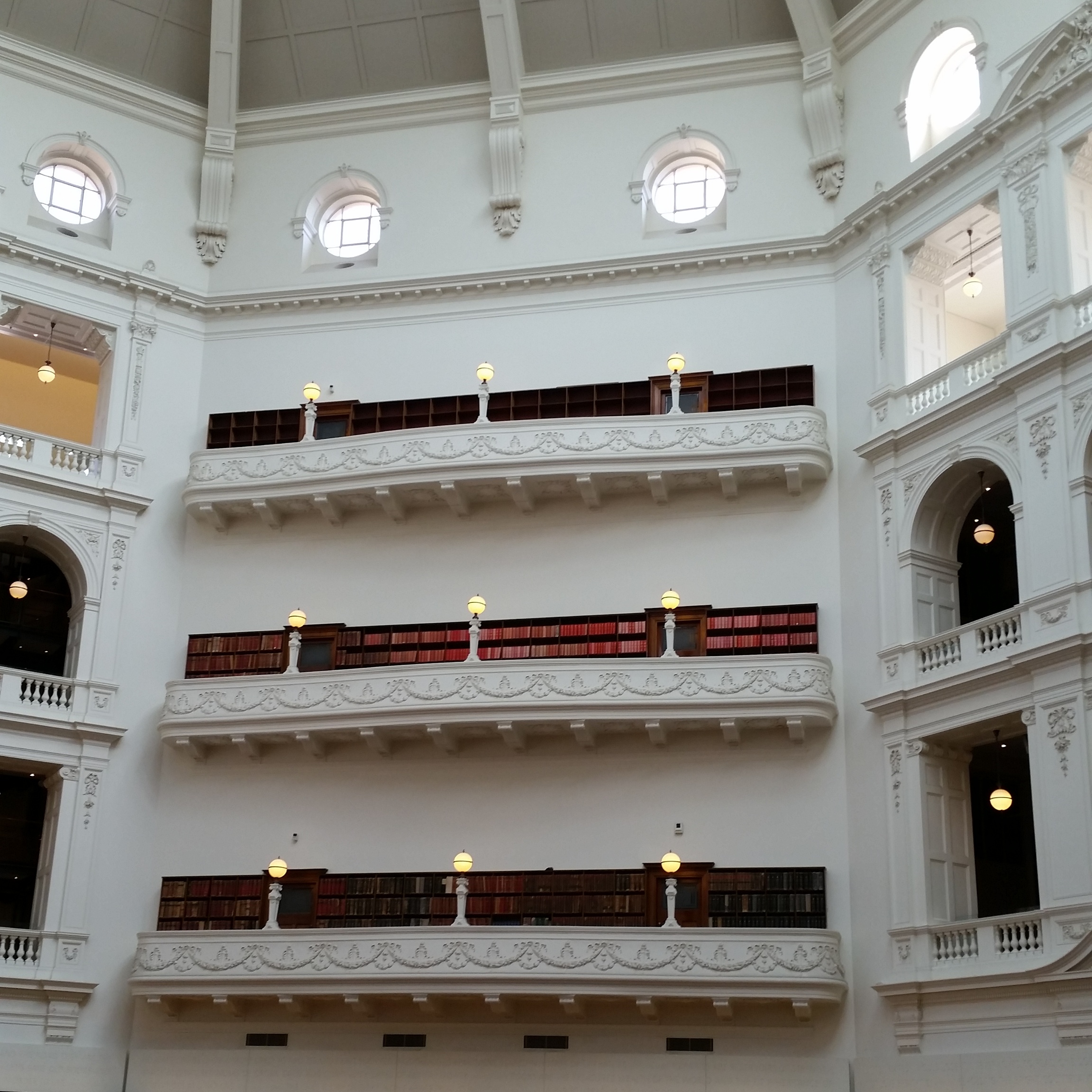
Inside, the library was filled with readers. Most had their heads bent over a book. The cavernous room absorbed much of the sound but the room lacked the hushed quality I was looking for. I headed straight on through to admire the Redmond Barry Reading Room, a later addition to the original building. There too, every desk was occupied, but readers were more subdued and the magnificence and architectural uniformity of the mezzanine, and the glass-covered atrium, seemed to quieten the spirits. Here was not a room to rush around in, and my own footsteps on the polished wooden floor seemed overly loud!


I went next to the La Trobe Reading Room, my final destination, and where I sat for quite a while. The room felt higher than it was wide. Octagonal in shape, all the desks radiate from a central podium like spokes of a wheel. There were far fewer people about. I wondered if that had anything to do with the more austere atmosphere and less comfortable seats.  My photos, taken on my phone with the permission of security, scarcely do the room justice. I took strange angles as I was after images I could later use for descriptive purposes. Besides, I am not a photographer.

I didn’t want to take photos. It felt wrong. Instead, I wanted to go up and explore the books on the balconies. I wanted to run about, my head appearing in all those arches. I wanted access to all the parts of the building closed off, sometimes padlocked as if to stress the point.

I reigned in my urges and went back to the information desk in the first room. There I introduced myself to the librarians. What a fine complement of staff the library has! I made some inquiries and was given vital information for my book. Now I have more questions. I might do a guided tour and see if that gives me access to some secret places. Whatever the case, I shall return.


Mayan Mendacity by L.J.M. Owen

Dr Elizabeth Pimms has a new puzzle.

What is the story behind the tiny skeletons discovered on a Guatemalan island? And how do they relate to an ancient Mayan queen?

The bones, along with other remains, are a gift for Elizabeth. But soon the giver reveals his true nature. An enraged colleague then questions Elizabeth’s family history. Elizabeth seeks DNA evidence to put all skeletons to rest.

A pregnant enemy, a crystal skull, a New York foodie, and an intruder in Elizabeth’s phrenic library variously aid or interrupt Elizabeth’s attempts to solve mysteries both ancient and personal.


My Review (written for Sisters in Crime)

Set in Canberra, and in the Mayan empire in what is now Guatemala, Mayan Mendacity is the second in L.J.M. Owen’s Dr Pimms, Intermillennial Sleuth series. It is a challenge setting up the next book in a series and Owen has done so with finesse. The narration is light, buoyant, playful at times, yet ever observant, the result, a most satisfying read.

The main plot is driven by protagonist Dr Elizabeth Pimm’s new volunteer project, given her by the exacting Dr Marsh. She must assess an archeological find, the remains of a cesnote in Guatemala, meeting a series of crushing deadlines. Elizabeth’s pursuit of answers to the mysteries of the find is continuously thwarted as a number of complications beset her. Obstacles and challenges come from all directions, enough to make the weak among us buckle, but not Dr Pimms.

Owen has created a convincingly flawed and utterly lovable protagonist. She’s determined, dedicated, thorough and loyal. She sallies forth with gung ho exuberance, never down for long, no matter what befalls her. Elizabeth’s attitude is probably best summed up when she confronts another disaster and asks herself, ‘What fresh new hell was this?’

Dr Pimms is supported by a cast of characters, all rounded out and believable. The reader is introduced to each in turn as the story unfolds and a secondary plot emerges, one that is deeply personal. Indeed, it is Dr Pimms’ own history that thwarts her investigation, yet ultimately leads her to mature and open her heart.

The story is thoroughly researched; the author clearly knows her themes and her setting. Technical details are provided in an engaging, easy to follow manner. This is especially evident when Owen opens a window on the fascinating world of the Mayan empire, making use of a parallel narrative to take the reader back to the time of Dr Pimms’ find.

Elizabeth’s phrenic library is an interesting addition to the narrative, a fascinating invention, one that creates a curious occult dimension to Owen’s series. This phrenic library is a personal and mundane version of the Akashic records, a metaphysical compendium of all that has ever occurred in human history, stored on the inner planes, according to Theosophical belief. As a device, Elizabeth’s inner library works well, granting her plausible, if esoteric, access to knowledge she would otherwise be hard pressed to gain.

In all, I found Mayan Mendacity difficult to put down. Owen has provided her readers with an entertaining story that also informs, without allowing exposition to put a brake on the narrative. Pulling off a story laden with this much technical detail and maintaining a fast pace is quite a feat.

The Museum of Modern Love by Heather Rose – book review

Heather Rose has produced a work of considerable finesse. The Museum of Modern Love sets a high bar for Australian literary fiction.

The Museum of Modern Love by Heather Rose, winner of the 2017 Stella Prize. Read more of my reviews at https://isobelblackthorn.com/my-book-reviews/


“Arky Levin is a film composer in New York separated from his wife, who has asked him to keep one devastating promise. One day he finds his way to The Atrium at MOMA and sees Marina Abramovíc in The Artist is Present. The performance continues for seventy-five days and, as it unfolds, so does Arky. As he watches and meets other people drawn to the exhibit, he slowly starts to understand what might be missing in his life and what he must do.”

It is always a delight to read an intelligent book. In The Museum of Modern Love, it is as though the author caresses the intellect through exquisite prose; coaxing, inviting engagement. Rose has produced a deeply introspective, slow-paced book, one that will appeal to lovers of literature, rather than those seeking page-turning entertainment.

The primary setting is the Museum of Modern Art in New York, where the main characters observe a piece of performance art by the renowned Marina Abramovíc, in which the artist sits unflinchingly still, all day for seventy-five days. The object of Rose’ pen is therefore a real life and contemporary figure, Serbian-born Abramovíc, who has loose and controversial associations with Australia. The Museum of Modern Love is faction, a considered rendering of biography in fiction.

What commences as the audience observes ‘The Artist is Present’ is the delicate unfolding of backstory, petal by petal, first here, then there, until the essence of the narrative, a poignant and bruised heart, is revealed.

It is her metier to dance on the edge of madness, to vault over pain into the solace of disintegration.”

Rose is a masterful writer, her depictions of incidental characters sharply observant, yet her prose is always gentle, haunting. The Museum of Modern Love is a meditation, on art and creativity to a large extent, but above that on pain, physical and emotional pain, the anguish of loss and grief. Can themes of art and creativity rescue a narrative that strolls along in the doldrums of lingering despair? The answer is immediate: Yes. ‘The Artist is Present’ installation represents trauma on a grand and complex scale, the artwork a culmination of a lifetime of suffering, depicted in a retrospective piece on display in the museum upstairs. Abramovíc’s artistic and personal pain is juxtaposed with the ordinary pain of ordinary people, yet each time another sits on the vacant chair and locks gaze with the artist, whatever they are feeling is transformed, subtly perhaps, to become a part of this ever changing, yet remarkably unmoving, work of art.

The narrator of The Museum of Modern Love is deft, light, observant, forgiving. If there could be a point of criticism it would be the use of self consciousness, at times the narrator identifying as a disembodied entity, an angel, a muse, naturally omniscient, one given to addressing the reader directly. Some may deem the exploitation of this device unnecessary and intrusive. When it first appears, the reader may be forgiven for worrying that this voice may overpower the narrative, but thankfully it does not.

All fiction is contrivance, a pasting together of characters, settings, themes. When drawing on real people and real events, such pasting can appear awkward and stilted. The Museum of Modern Love is not one of those works. Evident in abundance is Heather Rose’ passion for her subject and deep empathy for her themes. It comes as no surprise that the work won The Stella Prize, 2017.


Domingo Díaz Barrios

Sitio web de mis obras

Soul to Spirit: The New Spiritual Psychology

Becoming Human, Becoming Soul, Becoming Spirit

The Dark Side from the Inside

Writing and Reviews from Dark Places

Bookinton

Book Blogging , Short Stories , Reviews , literary web-series and EVERYTHING FICTION !

Mitch Horowitz

Author • Lecturer • Narrator

ARMAND ROSAMILIA

Author of Thriller, Horror, Nonfiction stories and more

BOOKS FROM DUSK TILL DAWN

Each night I TRAVEL THE WORLD, I LIVE IN THE MIND OF KILLERS AND WALK AT THE SIDE OF HEROES

Passport Overused

Showing the beauty of this world through the people, places and culture

BooknVolume

For the Love of Words, Art, Nature, and Spirituality

THE BLOGGING STATION

LIFESTYLE, BEAUTY AND EVERYTHING IN BETWEEN

Frankly Wright

I give you my opinion whether you ask for it or not.

a good book, a good life

comments on books by Ann Creber

Carmel Bendon

Writing tales of then and now and the in-between