Colonisation in Reverse
Louise Bennett (1919-2006)
I’m sharing a poem I first came across in the 80s when I was studying a course with the Open University, UK, called, ‘Third World Studies.’ It was a brilliant multidisciplinary introduction to the North South divide. Hats off to the OU for that seminal moment in my life.
The 80s seem a distant memory but so much of what we see happening and complain about today has its roots in that time of transition, from widespread social democracy in the North, with Keynesian influenced economies holding Capital in check, to Neoliberalised economies in Northern nations, whose citizenry find themselves going through the same sorts of austerity strictures imposed decades earlier by the IMF on the South. The South could have told us what would happen and how it would feel.
Savvy Southerners have devised all sorts of strategies to survive. Colonisation in reverse is one of them. The logic of it goes something like this: “Since you invaded our lands, took us over, came in your thousands and squeezed yourselves in, stole our resources and rendered us destitute, we will do the same to you.”
http://www.MintPressNews.com
I’ve reposted the poem from where it appeared in New Black Magazine, May 6, 2007. It is written in Patois. It’s hilarious, and I think we could do with a little laughter right now.
Colonisation in Reverse
(You can hear Louise Bennett tell her poem here – go to 4.48mins
Wat a joyful news, Miss Mattie,
I feel like me heart gwine burs
Jamaica people colonizin
Englan in Reverse
Be the hundred, be de tousan
Fro country and from town,
By de ship-load, be the plane load
Jamaica is Englan boun.
Dem pour out a Jamaica,
Everybody future plan
Is fe get a big-time job
An settle in de mother lan.
What an islan! What a people!
Man an woman, old an young
Jus a pack dem bag an baggage
An turn history upside dung!
Some people doan like travel,
But fe show dem loyalty
Dem all a open up cheap-fare-
To-England agency.
An week by week dem shipping off
Dem countryman like fire,
Fe immigrate an populate
De seat a de Empire.
Oonoo see how life is funny,
Oonoo see da turnabout?
Jamaica live fe box bread
Out a English people mout’.
For wen dem ketch a Englan,
An start play dem different role,
Some will settle down to work
An some will settle fe de dole.
Jane says de dole is not too bad
Because dey paying she
Two pounds a week fe seek a job
dat suit her dignity
me say Jane will never fine work
At de rate how she dah look,
For all day she stay popn Aunt Fan couch
An read love-story book.
Wat a devilment a Englan!
Dem face war an brave de worse,
But me wondering how dem gwine stan
Colonizin in reverse.
——————————–
Silencing the lambs: Asylum seekers are a metaphor for our times
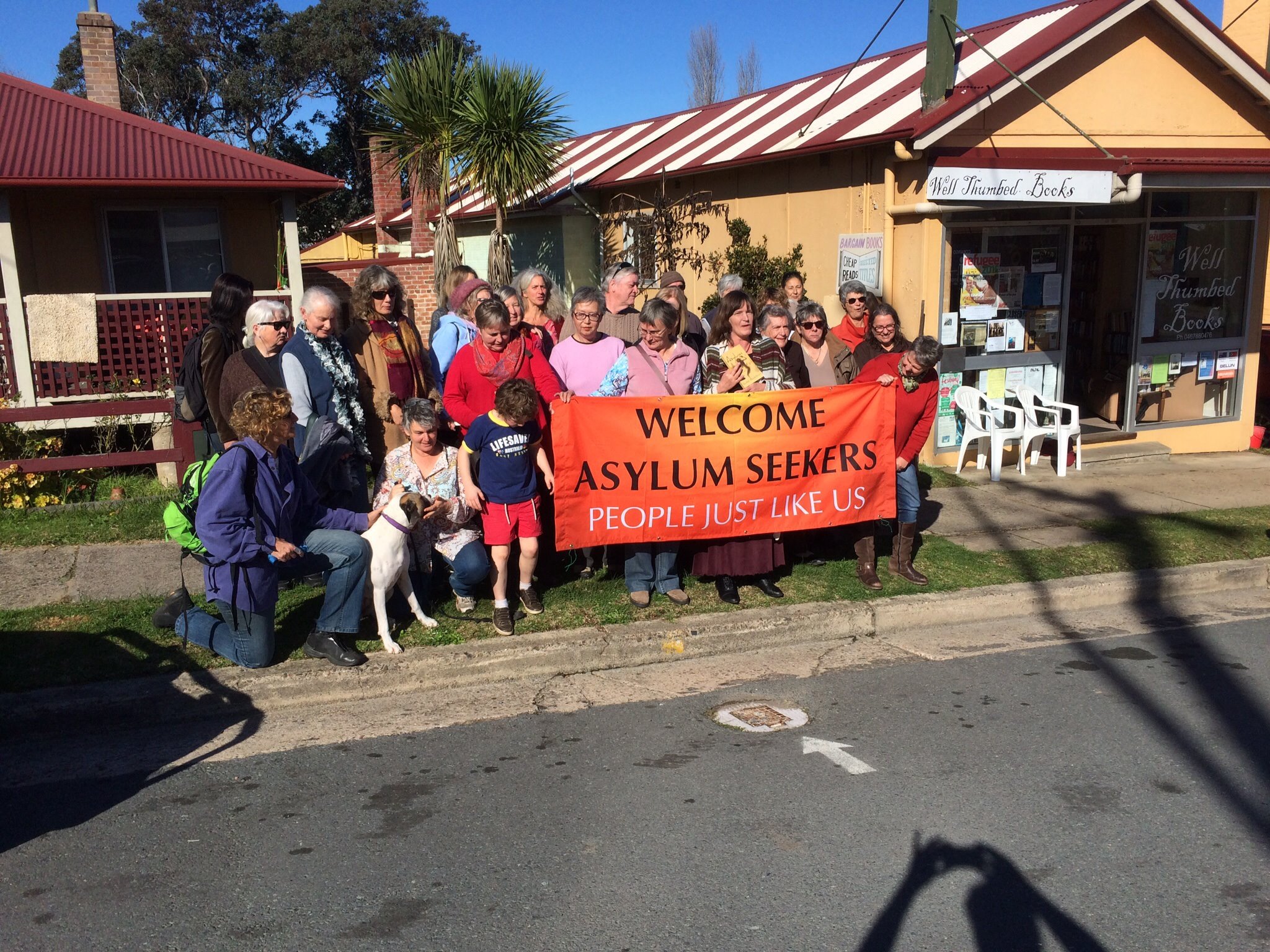
On Line Opinion have just published my latest piece on asylum seekers, for which I am very grateful. The photo here sums up my belief in what Australians are capable of. If this many can gather behind a banner in a tiny village in the middle of a wilderness, then we can only imagine the swell of people standing up, standing for, standing behind this one banner, a banner that represents solidarity with those at the pinnacle of all that is wrong with the world today – asylum seekers.
Here’s the article –
Silencing the lambs: Asylum seekers are a metaphor for our times
Asylum Reviews
Today I found two reviews of Asylum on NetGalley which I just had to share!
The first is by Tanya Brough – “Have you ever felt like just dropping everything and running far, far away? To perhaps an island? That is what Yvette Grimm did. She ran from her life in Malta and her boyfriend Carlos (what an oaf!) and met up with her mother, Leah, in Australia. She wants to stay and her mom wants her to stay. There might even be a man on the horizon, but that will always be a complicated situation with Yvette, a romantic at heart. I thoroughly enjoyed Asylum. Yvette is such a lovable, but emotional human. You can even feel her hurt when her mother is a little cold towards her, always talking about her sister. Asylum is just the right book at the right time for me. Yvette, we sistas in arms.” Tanya gives Asylum 5 Stars.
Then Rachel Bustin wrote,” My initial thoughts were that the cover seemed a little bland, but I always go by the saying, ‘Never judge a book by it’s cover’. I did like the thought of reading a very strong character driven book, and this is what the book is. The story starts off with Yvette Grimm finding herself back in her childhood bedroom at her mother’s Leah’s house in Australia. She is on a holiday visa at the moment, but Leah has sent off her permanent residency forms. Yvette had to leave her old life in Malta. As you read through the book, you discover what Yvette’s life was like with her boyfriend Carlos through little snippets, and why she had to leave. I love this little quote. The author uses a fantastic style of writing throughout, to the point and very clear. ‘Yvette was seeking refuge from the wreckage of her life’ Yvette’s mother tells her that she must get married to stay in Australia, but Yvette is a sort of a hopeless romantic and believes that you marry for love not convenience. The story follows Yvette through her struggles of belonging nowhere. Yvette takes you to a cockroach infested flat, to a cute little house to singing in a choir and a life changing event. It was a beautiful journey that the author took me on. Laughing in places, crying the next. I loved the character of Yvette, she never let anything get her down, she was always expecting the worst, and this made her a much stronger person. I didn’t like her mum Leah, she seemed very cold towards Yvette, and always going on about her sister Debbie, which made Yvette feel alone at times. I think the main idea of the book is to inform you about the difficulties that people have in gaining residencies. Even though Yvette’s mum and sister live in Australia it doesn’t make her a definite case to live there permanently, just because she stayed with her dad in England when her mother and sister moved back when they were children. I find the topic on political asylum quite fascinating and this book does question that. I would love to read other books with a similar topic to this one, it was a fascinating read. I would recommend to anyone looking for a strong female character lead. I gave Asylum by Isobel Blackthorn 4 out of 5 stars.”
Many thanks Tanya and Rachel. I’m enormously chuffed and grateful. Cheers!
Asylum seekers: confronting the double face
There are two faces to Australia’s asylum seeker policy. There is the outward face, all smiles and hooded eyes, that espouses ‘stop the boats’ mantras to indoctrinate the masses. We are to be persuaded of the necessity for harsh, inhumane treatment of asylum seekers journeying by boat. We are to disregard these peoples’ basic human rights and apportion blame for all their suffering on the shoulders of the smugglers. We are thus exonerated from guilt. We need look no further, for our government is right, opportunism is to be condemned. It is only us who gets a fair go.
The outward face is a veil, a mask. It has been constructed to hide what lies within.
The inward face wears a bland expression. Eyes stare in blank denial, mouth set firm. This is the face of systematic brutality, a daily occurrence in detention centres both on and off shore. Not a day goes by without advocates passing on testimony of the violations of normal respect and decency, and of the systematic cruelty, degradation and psychological torture. Not a day goes by bereft of the despair of those incarcerated and their supporters. It makes for harrowing reading. Through these reports, and through such books as Antony Loewenstein’s Profits of Doom I have come to understand the cool, calculated methods used by corporations (Serco, G4S, Transfield) running these ‘facilities,’ the clinical way they go about their business, all manner of unspeakable decisions justified by the profit bottom line. Bloodsucking corporations filled with a cohort of Adolf Eichmanns.
For there is but a whisker of difference between the orders that are issued, and the manner in which they are carried out, in detention centres and in the Holocaust camps.
“I go down to the jetty, where several dozen DIAC, Serco, police and Customs officials, as well as interpreters and ambulance staff, await the arrival of the refugees. A number of CI residents and tourists are there too, and are mostly middle-aged or older. The ones I talk to all express opposition to refugees. They are “illegals” who might come and “take over”, like “what’s happening in parts of Europe”. One person says, “They should be pushed back to Indonesia, where they will be safe. Why are they coming to Australia? What if terrorists are on the boats? We have poverty here and people living in bad conditions on CI, but they come and are treated better than Australians”. I mention Serco and ask whether anyone cares that a private company is making money from greater numbers of refugee arrivals. One older man says he feels uncomfortable about it, while a tourist isn’t aware of the fact.”- Profits of Doom
“Curtin is surrounded by scrubby desert as far as the eye can see. I can’t imagine a more isolated place to be detained. Demountables are scattered beside the road near the car park and high barbed-wire fences surround the detention compound. We can see new houses being constructed nearby, and a freshly laid concrete pathway leads to the main entrance. The last years have seen the construction at the centre of gymnasiums, religious rooms and classrooms…Serco posters and signs advertising the company are ubiquitous in the reception area. They display the smiling faces of happy staff and multicultural imagery that includes a Muslim imam. A colour brochure emblazoned with four grinning faces from various racial backgrounds sits on a small table near some lockers.‘Bringing service to life’ is the company’s motto. The pamphlet says that Serco ‘promotes the inherent dignity of people in detention in line with the Australian government’s new immigration detention values’. A number of other pieces of Serco literature are scattered around reception. ‘Visitor Conditions of Entry’ states that there are three visiting periods every day, including between 6 p.m. and 8 p.m., but also says that arrival after 5 p.m. will not be permitted. There are dozens of rules and regulations on the sheet, including: ‘Respect the privacy and dignity of all people in the centre’. It’s a noble goal, but one that staff routinely breach, detainees later tell me.” Profits of Doom
“….We unloaded the motor. It was a heavy Russian benzine engine, at least 200 horsepower. we installed the engine on a concrete foundation and set up the connection between the exhaust and the tube. I then tested the motor. It did not work. I was able to repair the ignition and the valves, and the motor finally started running. The chemist, who I knew from Belzec, entered the gas chamber with measuring instruments to test the concentration of the gas. Following this, a gassing experiment was carried out. If my memory serves me right, about thirty to forty women were gassed in one gas chamber. The Jewish women were forced to undress in an open place close to the gas chamber, and were driven into the gas chamber by the above mentioned SS members and the Ukrainian auxiliaries. when the women were shut up in the gas chamber I and Bolender set the motor in motion. The motor functioned first in neutral. Both of us stood by the motor and switched from “Neutral” (Freiauspuff) to “Cell” (Zelle), so that the gas was conveyed to the chamber. At the suggestion of the chemist, I fixed the motor on a definite speed so that it was unnecessary henceforth to press on the gas. About ten minutes later the thirty to forty women were dead.” – Testimony of SS Scharfuhrer Erich Fuchs, in the Sobibor-Bolender trial, Dusseldorf
“Before the Jews undressed, Oberscharfuehrer Michel made a speech to them. On these occasions, he used to wear a white coat to give the impression that he was a physician. Michel announced to the Jews that they would be sent to work, but before this they would have to take baths and undergo disinfection so as to prevent the spread of diseases… After undressing, the Jews were taken through the so-called Schlauch. They were led to the gas chambers not by the Germans but by the Ukrainians…After the Jews entered the gas chambers, the Ukrainians closed the doors. The motor which supplied the gas was switched on by a Ukrainian named Emil and by a German driver called Erich Bauer from Berlin. After the gassing, the door were opened and the corpses removed….” Testimony of SS-Oberscharfuehrer Kurt Bolender, In the Belzec-Oberhauser trial
The inward face is ugly. It portrays the clinical indifference of the psychopath. There is no empathy and no conscience in the eyes. It is as if we are witnessing the emergence of a plethora of death camps, a many headed Hydra, one that has learned from past mistakes and chosen psychological over physical death of inmates as the path of preference. There is profit, as long as they stay alive.
And a sort of psychological death is the reality especially for children and long-term detainees who must suffer the ordinary mundane tortures of life on Nauru, Manus or Christmas Island, or Curtin, Villawood or any other gulag. Such tortures do not extract blood, do not cause extreme physical pain. Instead, the methods are not dissimilar to those enacted by a perpetrator of domestic violence. They are designed to drive a person mad.
Asylum seekers are not a problem: they’re people
With thousands of asylum seekers and refugees in the Straits of Malacca, crammed into boats without food and water, rejected by country after country and towed back out to sea, the desperation of vast numbers of people scrambling to reach safer shores could not be starker. They may be fleeing terror. They may be fleeing destitution. And we must strive to understand the circumstances of such flights in their entirety before we dare to point an accusatory finger.
The blame game will only succeed for so long. A hugely successful propaganda technique is to isolate the ‘fall guy’ and blame to the hilt. When it comes to asylum seekers, we are told to blame the people smugglers. While I dare say such traffickers are not my kind of folk, because I prefer to spend time with people with scruples, they are, like many agents and go betweens, providing an essential service, and making a profit out of the fee.
In The last time they turned back the boats, Jeff Sparrow draws a parallel between the rejection of the Bangladeshi and Rohingya refugees and the Jews on St Louis, and our ‘casual indifference’ to such atrocity. Such indifference is cultivated in part through a manipulative play on our fears, of terrorism, and of ‘opening the floodgates to job stealers.’ Thus a nation may stand firm against ‘marauding outsiders’, control its borders with impunity, its citizenry hardened into callous yet bogus self-preservationist attitudes.
What is alarming about today’s situation is that we are able to turn our hate-fueled eyes in the direction of any and all outsiders, wherever they come from. And the causes of asylum seeking are ignored.
Yet unless we examine those causes, we will be complicit in an evil as great if not greater than the Holocaust. People take flight when fight is not possible. When villages have been razed, towns ethnically cleansed, when the women are raped and the men slaughtered. When there is nothing left to eat or drink. People flee because they are desperate. The decimation of the Middle East, the ongoing violence and oppression across North Africa, Myanmar, the civil war in Ukraine, are but a few examples.
We are also on a precipice. Climate change is already spawning refugees. Bangladesh, home of 156 million people, is slowly sliding under the sea, village by village.
And let’s not forget there are huge sums to be made out of refugees. (And of course war) Who cares about human suffering when profits can be gleaned running detention centres? In fact, refugees make more money than prisoners, so bring it on. The more suffering the better. This sort of statement is not seen on Serco’s home page, or G4S’s, but it should be, and if these corporations told the truth about themselves it would be.
Serco, a corporation run by the super-rich. A corporation that profits out of the poor. That sucks from the teat of the tax payer’s bottle confident the bottle will never run dry.
In essence, asylum seekers exist because the super-rich exist. Because such people are expendable. The reality is that we are all expendable. The insanity of the situation we are living in is that of a parasite determined to kill its host.
Australia is a world leader in a universal cruelty. When St Louis was looking for a home, the locus of evil was Germany. Now we have multiple loci as country after country seeks to guard and close its borders. I have no idea how this will end. I suspect that there will be much horror ahead before it does.
Vale Alex Legg
Alex Legg (1952-2014) was an inspiration to so many musicians. A master songwriter and troubadour whose memory will live on through his songs.
Photo by Kylie Horner
I was privileged to have spent two fine years by his side. So when NSW Folk Federation invited me to write a tribute for their magazine, Cornstalk, of course I agreed.
The article can be accessed here – Cornstalk
Or, read on:
“After a sudden and intense battle with cancer, Alex Legg, age 62, passed away on the 3rd December 2014, leaving behind his son Angus, his sisters and brothers, and nieces and nephews in Scotland, and the swathe of musicians he inspired. Alex led a rich and interesting musical life since writing his first song at twelve years of age. By the time he was fourteen he was playing bass in Scottish dance band, Dave Barron’s Baronettes. After playing bass in a number of Aberdeen bands, including Hedgehog Pie, he moved to London in 1974 and spent the following thirty years songwriting and gigging, finally moving to Melbourne, Australia with his then wife Jenny and son Angus, and two contact numbers in his phone book. From such tenuous beginnings, Alex went on to forge a successful musical career in Melbourne, especially in the Dandenong Ranges where he ran Kelly’s Sessions, at Kelly’s Bar and Grill, Olinda, easily the greatest open mic in the world and a training ground for many emerging artists. Alex nurtured the talent and gave freely his own hard won wisdom, encouraging singer songwriters to work up a three-hour set and get themselves out there. He would even help to book them gigs. Alex also hosted a monthly Blues and Roots night at Burrinja Arts Centre café, featuring Nick Charles, Fiona Boyes, Andy Cowan, Phil Manning, Kavisha Mazzella, and Lloyd Spiegel and many more top Blues artists, all of whom held Alex in the highest regard. Alex was a master songwriter and consummate performer, his stomping grooves and rich vocals the perfect delivery for songs of passion, loss and social justice. Alex will be remembered for his award-winning songs like Too Many Children and Heaven Help Me; songs he considered simple and funny like Leather and Lace and Forget It (another award winner); and songs like May All Your Friends Be Artists which he wrote for his son Angus, songs that strike at the hearts of many. At the time of his passing he was working on an album featuring the great Albert Lee on guitar. The album was originally to be titled Cupid’s Graveyard after one of the tracks. Towards the end of his life Alex decided to re-name the album Leggacy. I think it was a wise choice. Alex had a huge heart and a giving & generous nature and he has left us with a song catalogue second to none. His songs are his legacy. Here is Heaven Help Me, a song that Joe Cocker passed over and Johnny Neel recorded in 2004 can be found on YouTube” Isobel Blackthorn
In peace…
The Prague Cemetery – a belated review
The number of authors fascinated by metaphysics and the supernatural never ceases to make me wonder about the relationship between the creative psyche and that vast realm of the imagination.
There are those who immerse themselves in mythical and symbolic riches and create complex fantasy landscapes. I’m not a huge reader of fantasy and can only mention Ursula le Guin’s The Earthsea Trilogy, which I have read and thought amazing.
Others tackle the metaphysical side of reality in more direct ways, taking journeys into the supernatural and occult. Bram Stoker’s Dracula seems a good early example.
There are the magical realists from Jorge Luis Borges on, who include the paranormal in their stories as if it were a given. Isabel Allende’s The House of the Spirits is just one example.
Then there are those who embed their insights to give shape to themes. I think of how Doris Lessing’s interest in Sufism inspired her Canopus in Argos Archives.
And it seems that down the ages many writers, along with artists, composers and scientists have had more than a passing interest in the occult. I found a list on a website of Rosicrucians and was astonished to find Bram Stoker, Isaac Newton, Victor Hugo, Yeats, Satie, Edith Piaf and Walt Disney on the list, along with more obvious suspects, such as Jacob Boehme and Francis Bacon. I have no idea how accurate the list is or how immersed in Rosicrucianism each person listed may have been.
I do know a fair bit about the occult though, or western esotericism as it is more properly called. Which is why I found Umberto Eco’s The Prague Cemetery such a compelling read.
The Prague Cemetery might seem at first like a cook’s tour of the upheavals and power struggles of Europe at the time, written from the perspective of a fierce anti-semite. The basic plot is very simple, the reader uncertain as to whether the protagonist, the repugnant Simonini, has a split personality.
Following Freud’s thinking on the matter, Simonini, who seems to have no idea himself, decides to write a diary to find out. What ensues is a journey through the latter part of he nineteenth century, as Simonini, a master forger of documents, becomes immersed in a web of lies, misinformation, and elaborate inventions of truth designed to discredit the Freemasons and the Jews. Simonini is an unscrupulous psychopath, who works for the secret service of first Italy, then France. What is remarkable is that every other character in The Prague Cemetery existed in reality and all the historical events and those involved are verifiable.
While much has been made of Eco’s fictional depiction of the notorious The Protocols of the Elders of Zion, a complete invention that inspired Hitler decades later, in my view a subtler and more general point is being made.
That behind the scenes of history there are those hard at work creating one conspiracy theory after another, whether in fiction or as apparent fact, in other words conspiring to accuse others of a conspiracy in order to fulfil their own agenda, an agenda as simple as personal greed.
I salute the author for hammering this point. For it is my contention that the ultimate coup of the propagandists today is the discrediting of the very conspiracy theories they themselves have created in order to cement in the zeitgeist the view that all conspiracy thinking is rubbish, thus allowing them a huge freedom to continue to conspire.
Umberto Eco’s interest in western esotericism is well known. Through his fiction he explores this world within the world while keeping himself distant from it. An observer, not a practitioner. A thinker who questions and probes, not an adherent who adopts without question. It is this distance that allows him to write works like The Prague Cemetery.
Welcome to Australia
I woke this morning at about five o’clock to the sound of cock crows and magpie chortles, knowing that my third piece, Welcome to Australia, would appear in On Line Opinion today.
It’s a controversial piece and in the pre-dawn darkness I feared some would misread it and accuse me of being anti-Australian. Then I thought that if they did, it would only serve to strengthen one of the themes.
My thoughts wandered on to all the different sorts of people who are against our treatment of asylum seekers. From human rights lawyers such as Julian Burnside, to doctors, actors, musicians, writers, teachers, religious groups and social advocates, Liberal voters, Labor voters, Greens voters, all sorts of people motivated by all sorts of factors.
The bottom line for all of us is that we care.
Why do I care? What motivates me? Before the break of dawn I recalled my relatively late entry into the asylum-seeker cause. It was entirely the result of investigative journalist Antony Loewenstein’s book, Profits of Doom. A fast-paced read taking the reader from Curtin to Christmas Island, then on to PNG and beyond. Of concern to Loewenstein is the role that transnational corporations such as Serco and G4S and Transfield play in the detention of asylum seekers. He calls them vulture capitalists. I think that’s an apt description.
And such corporations don’t restrict themselves to running detention centres. They run our railways, our hospitals, our courts, our prisons, our defence services, anything in fact that governments outsource. Even, if our government has its way, Medicare.
I can only conclude that asylum seekers held in indefinite detention are profiting these vulture corps in exactly the same way as we profit the very same corporations the moment we hop on a train. Corporations who also profit from our taxes, which our governments hand over in payment for their services.
Asylum seekers are the ultimate victims of this system. Like prisoners, the longer they are there, and the more of them there are, the greater the corporate profit.
Yet there is no separation here. We are all victims of the same system.
I think that is why I am so passionate about the mandatory detention of asylum seekers. They are lambs, sacrificed in the name of a dollar god.
A Tribute to Alex Legg
It is with huge sadness that I write this. Not twenty-four hours have gone by since the passing of consummate songwriter and performer Alex Legg.
This morning I was so moved by all the messages of love and goodwill on facebook I wrote a short story to contribute to his memory. It’s no more than a vignette. I wanted to capture something of the private Alex, the man I knew so well; his humour and imagination that bubbled continuously behind the scenes. Incredibly, the ABC have published it straight away. This story is for his son, his siblings, his family and for his ark of fans and friends who leave no room aboard for even a fly.
Follow the link to read it: Alex Legg, born 1952
I was fortunate to spend two sweet years with Alex. I went to all of his gigs and applauded every song. I guess I lived inside his song bag so to speak, and each one grew on me so that now I’m covered in them like a rash.
His music is a feast for the ears and the heart. His lyrics have an aerodynamic quality found in the great master songwriters, such as Paul Simon or Bacharach. Each song is carefully crafted with all the hooks and sweet melodies of truly great pop. He wrote in many genres: blues, folk, country, pop. He will be dearly missed but his music will live on. Here he is playing I’m Down at Camelot, Sydney.
Alex was a passionate man. We shared a take on the world and all its flaws. His views came out in songs. You Gotta Laugh Sometimes
And here’s one of my favourites. Some Old Junk Shop
Photographer and artist Marg Thompson has created this tribute to Alex – Thanks for Everything
Rest in Peace my friend.